An Aging Bridge
This webpage is best viewed in horizontal format
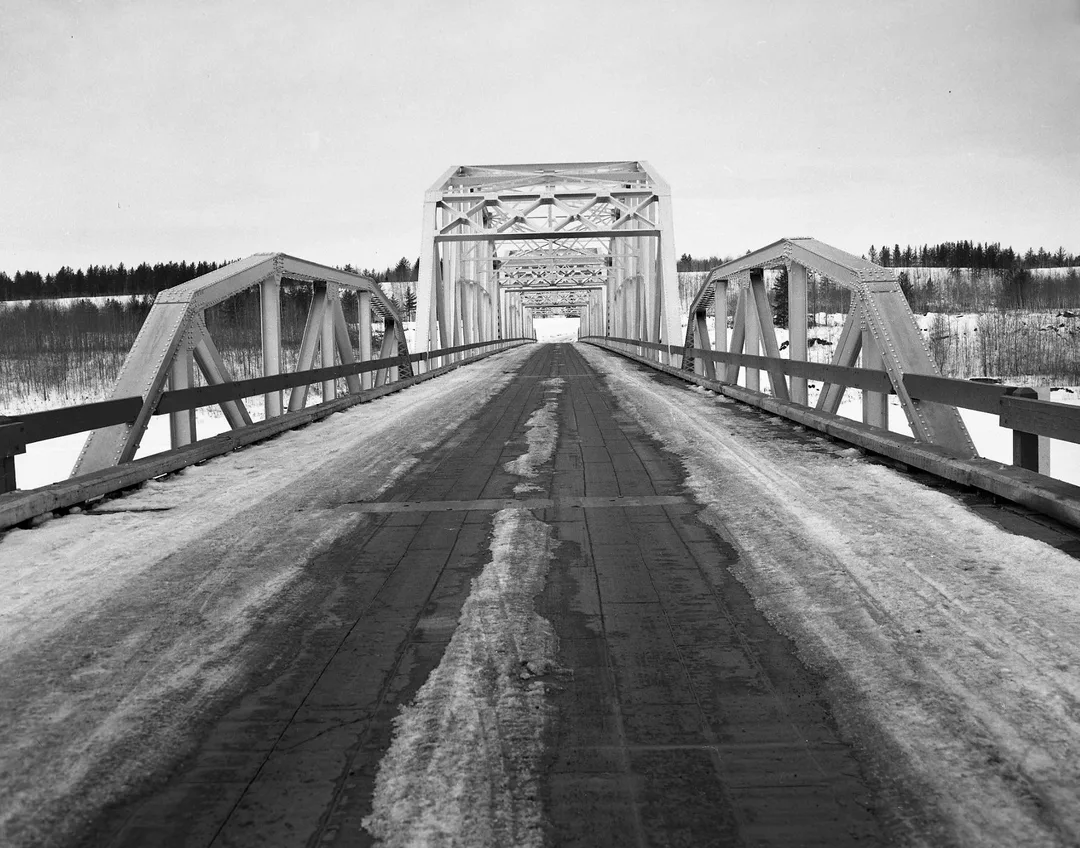
The Athabasca Bridge, 1952. Photograph by Bob Preece, Athabasca Archives AA022889.
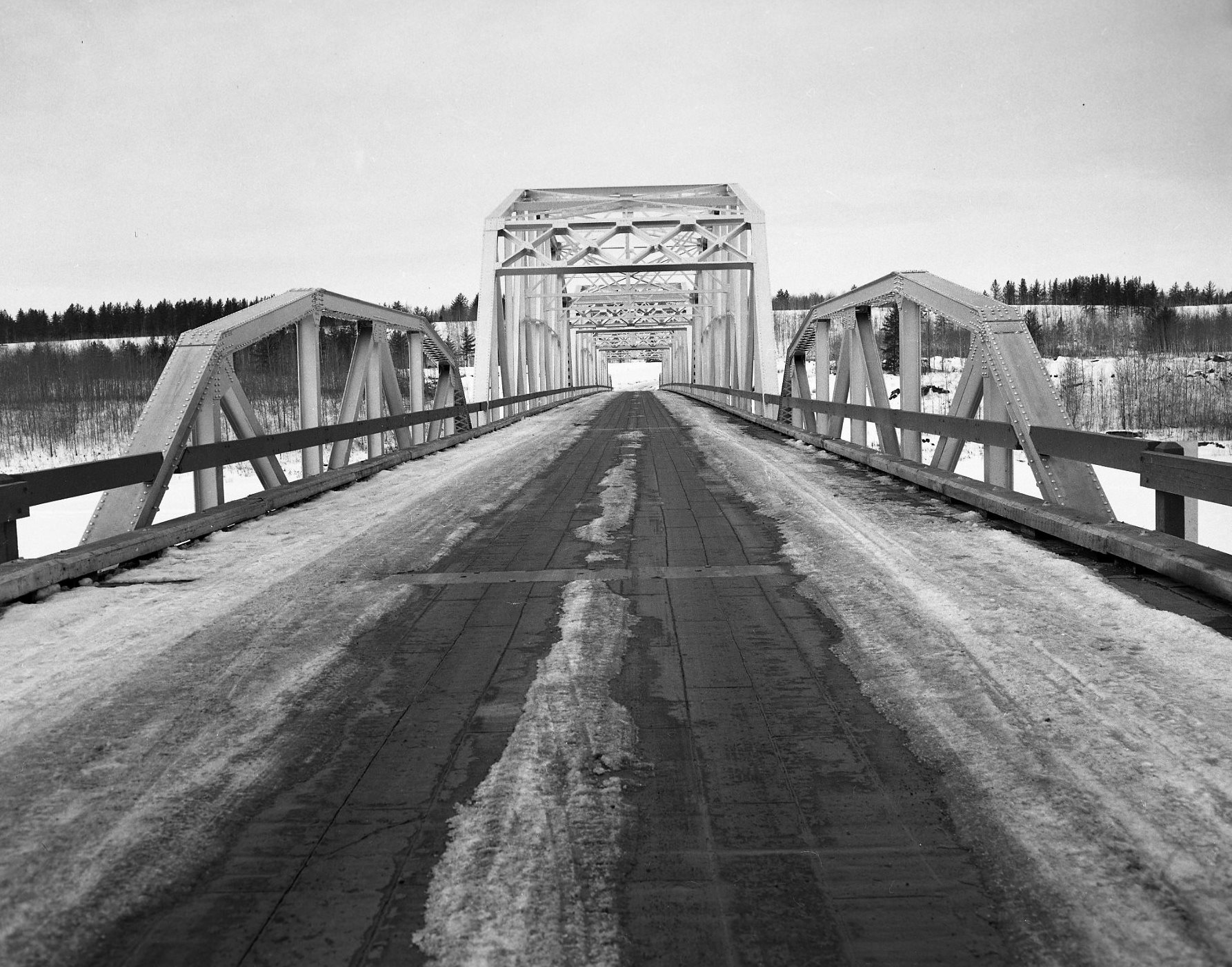
The bridge constructed in 1952 was a through-truss type built on piers sitting on solid rock ten to twelve feet below the river bed. The decking was laminated and creosoted 2 x 6’s set on edge topped with a layer of one inch asphalt plank. Early newspapers reported that it was built to withstand two 20-ton trucks travelling abreast. It met the needs of the farming community for many years.
While the bridge provided a lifeline for the people living or for industry beyond the river, it also opened the area up to those on the south side who were hesitant or saw little reason to use the ferry. Increasingly, traffic originating in the south was drawn north both for business and recreation. Gravel was plentiful north of town and Elmer Luker and Geoff Coke of Landing Transport set up a crusher in 1954. In 1961 they opened a cement plant – Athabasca Redi-Mix. Junior Fix leased land and built the first air strip which opened for use in 1957. The present golf course opened in 1962.
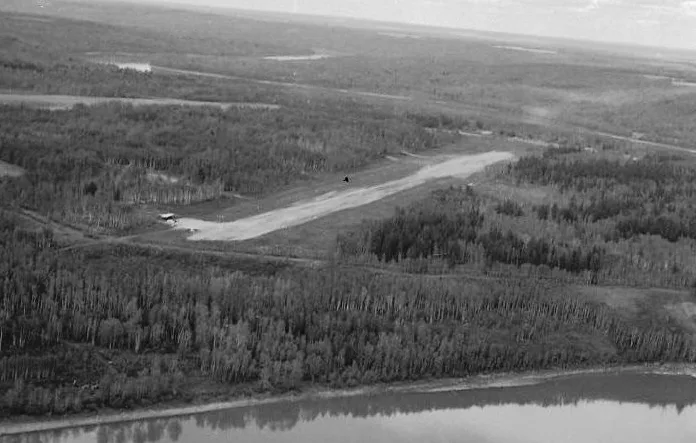
Aerial photo of the Athabasca airstrip taken from upriver in May of 1959. Athabasca Archives AA22007.
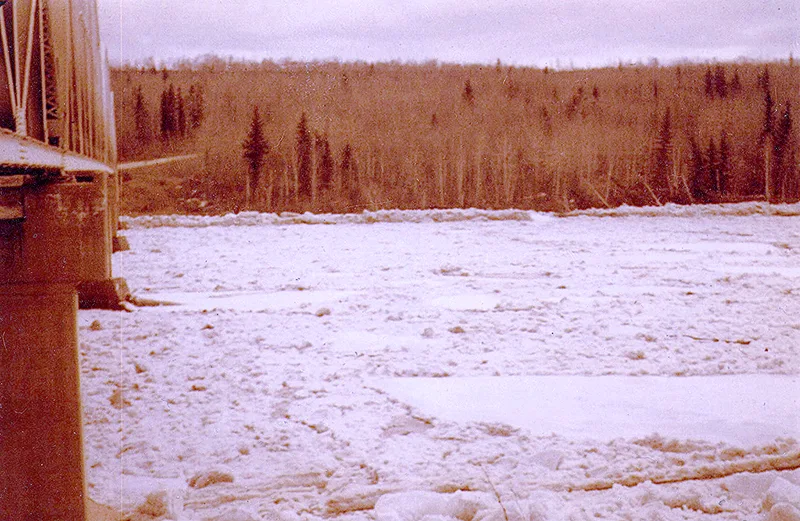
The bridge withstood its first big test by ice on April 19, 1963. The ice had gone out three days earlier but the water level was high and large floating chunks were caught up on the bridge. The water level climbed rapidly – the town water plant reported water levels rose in excess of 15 feet and some flooding occurred before the jam broke loose. One old-timer told of Frank Brown, town cop at the time, using a bullhorn to tell people to “Get off the bridge!” Quite a crowd gathered at the Welcome sign to take in the action.
The 1963 ice jam taken from the river bank beside the bridge on the north shore. Athabasca Archives AA17493.
The bridge had its decorative uses: in 1961 fireworks were set off on the bridge to celebrate Athabasca’s 50th birthday and in 1967 A-T-H-A-B-A-S-C-A was spelled out in lights on the side of the bridge during Canada’s centennial celebrations. Roy and Harriet Rogers opened a burger bar and dance facility which drew its fair share of traffic in 1967-68 and provided a venue for local talent.
On June 14, 1969, a fire of undetermined origin broke out on the town end of the bridge. At the time, many north-side residents were enjoying dinner in Athabasca celebrating the wedding of two well-known north-siders. The creosoted timbers created a huge pillar of black smoke and the fire department rushed into action – many of the firefighters came directly from the wedding. Water was pumped out of the river, through the fire truck and onto the fire. They were able to contain the blaze before the bridge was damaged beyond use and north-side wedding guests drove home across the bridge that evening. That winter an ice bridge was built across the river and north-side residents were once again travelling down to the ferry approach and crossing the river on the ice while repairs were made to the bridge.
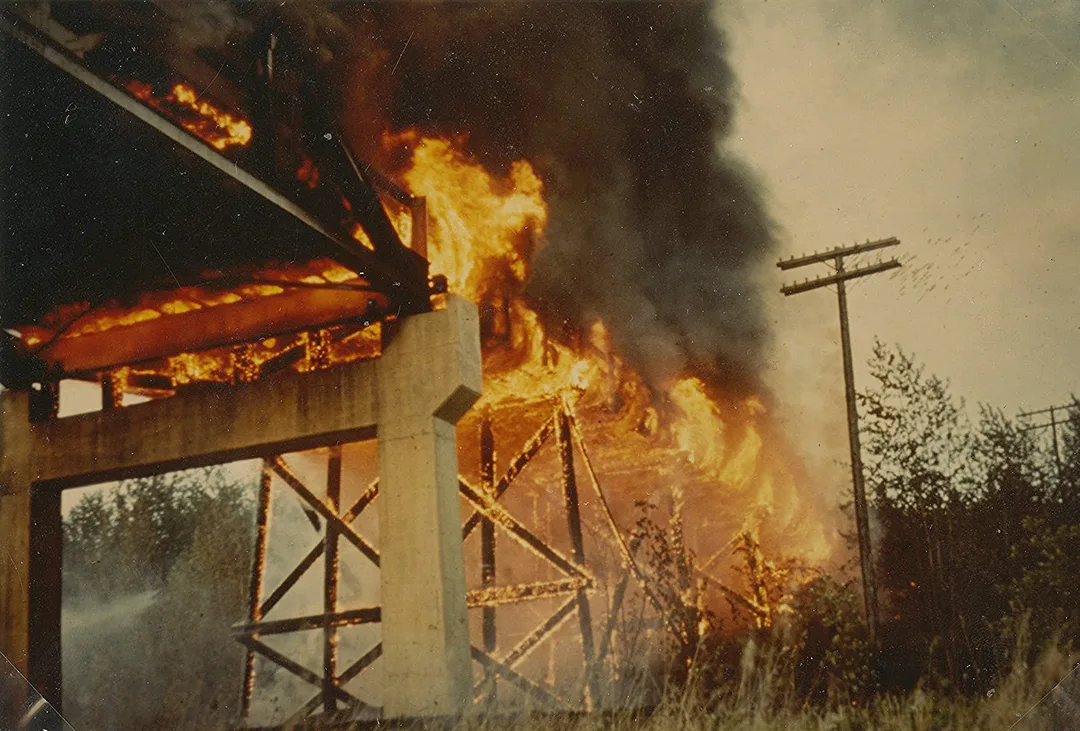
Athabasca Bridge fire, June 14, 1969. Athabasca Archives AA19536.
An ice bridge was in use again in 1981 when the bridge deck was completely replaced. At some point, the one inch planking had been replaced by 3 x 10’s. Now the 2 x 6’s on edge were replaced by 6 x 12 timbers and a new top put in place. The Athabasca Advocate of February 14, 1981 described the process of removing the old deck. “They pry the top part of the decking loose and a crane with a set of tongs pulls it loose. After the top portion of the decking is off a hook on the crane pulls the sub-deck out. Trucks can be seen going through town with the old timber loaded.”
In 1983 the Lion’s Club moved the rodeo grounds to the north side and now operates camping facilities and ball diamonds, drawing additional recreational traffic across the bridge. That same year the Agricultural Society proposed their development across the river and eventually moved into the Lion’s Recreational Park. Those facilities are in use year-round. The development of Highway 813 further increased bridge traffic. Lake lots opened up at Calling Lake and then a provincial park. Summer weekends see a steady stream of campers and trailers crossing the bridge to camping facilities near and far.
The dimensions of the bridge became a problem as loads increased in size. Stories were told of eaves being removed with chainsaws when houses proved too wide or air being let out of trailer tires to get those last few inches of height down – likely urban legends, but entertaining stories nevertheless.
By the mid-1980’s the push was on for an all-weather road through to Wabasca and the search for oil and gas sources was bringing heavier loads across the bridge. By 1989 Highway 813 to Wabasca was opened officially. On July 16, 1990, the Athabasca Advocate described a load moved across the bridge on its way to a CNR plant south of Calling Lake. A 175-ton load 18 feet high and 26 feet wide was moved slowly across the bridge stopping traffic for more than an hour. To lighten the load on the bridge, the truck was detached and a cable used to pull the load across the bridge. This across a bridge originally promoted as designed to accommodate two 20-ton trucks abreast! A steady stream of tankers carrying crude south was soon travelling across the bridge.
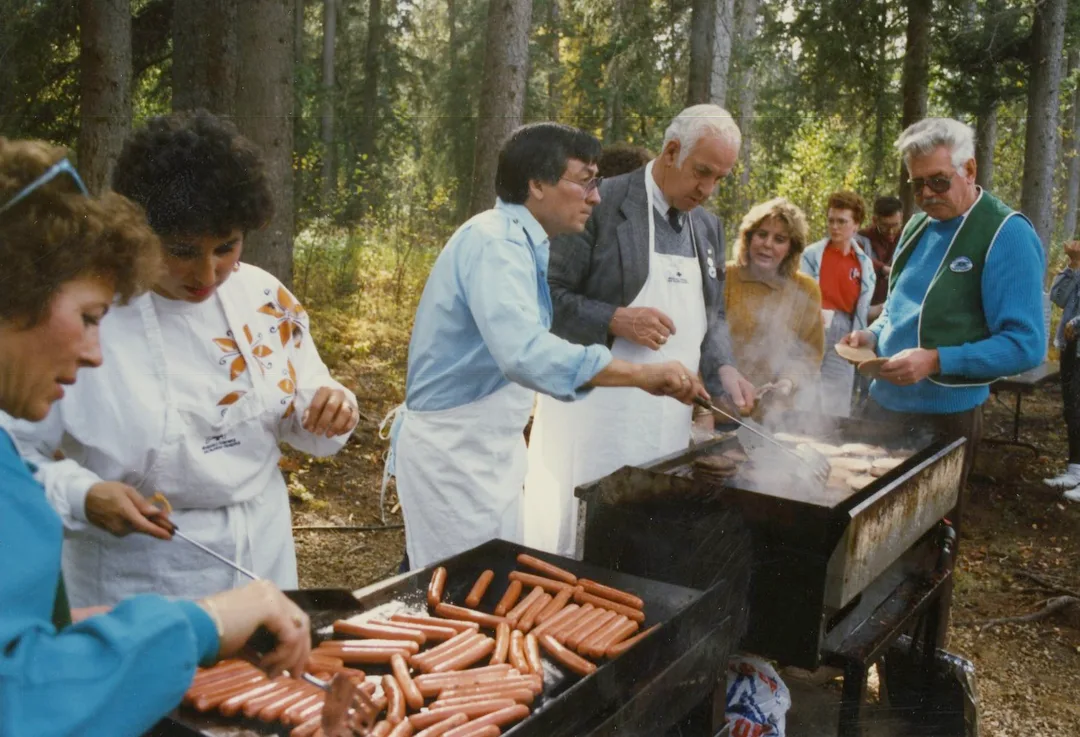
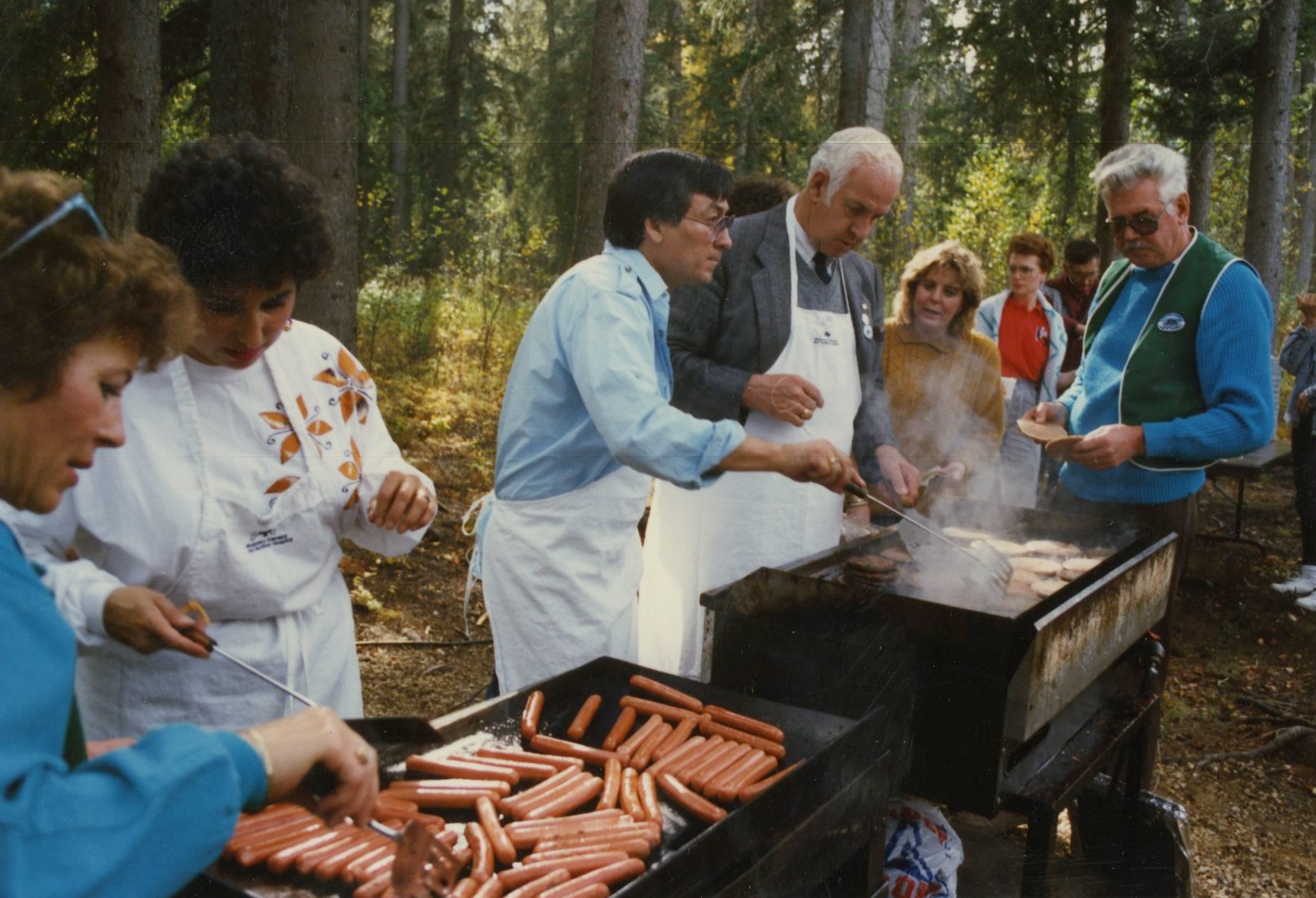
Barbeque opening Secondary Highway 813, Athabasca to Wabasca, on September 23, 1989. Left to right; Denise Plante, Pearl Callahasen, MLA Mike Cardinal, Al Adair, Edwina Bobocel, Mavis Jacobs, and Mayor Tony Schinkinger. Athabasca Archives AA21245.
By 1992 even loads hauled by farmers were becoming too much for the 40-year-old bridge. Weight restrictions were in effect and one farmer was quoted in the April 13, 1992, Athabasca Advocate as saying “They’ve upped the limits on the bridge but there can only be one vehicle on at a time, which is a temporary measure.” Large loads of logs were also crossing daily bound for mills near Slave Lake. The August 8 edition quoted Leon Root, assistant deputy minister of regional transportation as indicating that there were no plans to build a new bridge. The article went on to say, “… rodeo traffic placed additional stress on the aging surface. Divets and chunks out of the wooden planks were clearly evident after the traffic subsided. One five-foot chunk was replaced by town workers with a plank supplied by the Department of Transportation. But a new bridge is a $10 million touch,” said Root, “and economically, it is not viable. The current structure may not be adequate, but it’s safe. This bridge is sufficiently wide and strong. It’ll be around for a few more years yet,” Root added.”
The article went on to clarify whose responsibility it was to maintain the bridge. “The then mayor of Athabasca, Ole Hermanson, accompanied by town manager Cliff Sawatzky and Arnold Royko, met recently with Alberta Transportation to discuss maintenance of the bridge. Because the bridge was built within town limits, if falls under the jurisdiction of the town’s maintenance program. According to Randy Bredo, regional bridge technologist with the department of Transportation, the town is responsible for maintaining the bridge, keeping it safe and making minor repairs.
“Anything major is their responsibility,” said Sawatzky. In a recent letter to the town office, Bredo outlined what maintenance was expected within the town’s normal capabilities: the deck must be kept clear of dirt and gravel, the salt washed off the steel each spring and unsafe holes repaired in the stripdeck as required.”
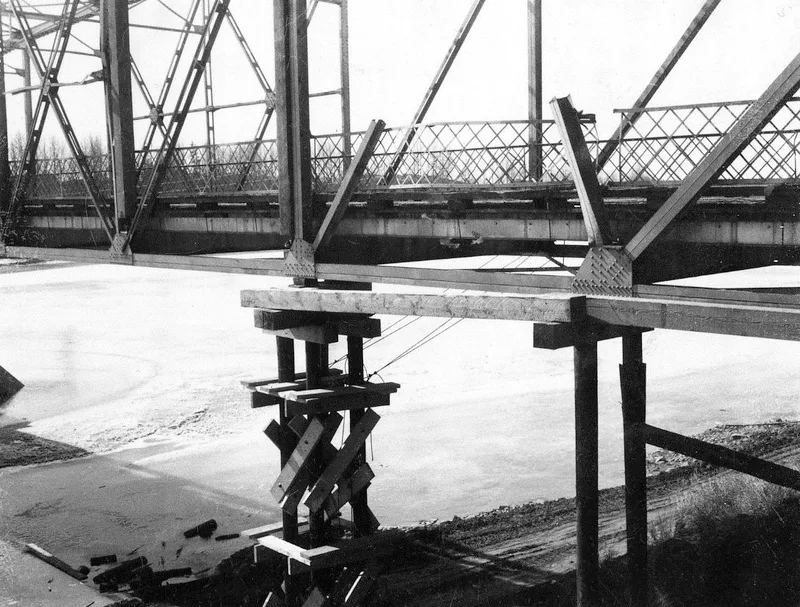
Temporary bridge repair in place, circa 1970s. Athabasca Archives AA04670.
Serious accidents on the bridge were fairly rare. In November of 1995 the Advocate ran photos of a piece of logging equipment which came partially off the trailer it was loaded on and the bridge and Highway 813 were closed for four hours. No injuries were reported, but north-bound school buses were held at Edwin Parr Composite School until the bridge reopened.
Alberta Transportation made major repairs to the bridge in 1996 which were estimated to take between four to six weeks. There would be single-lane traffic between 8 a.m. and 4 p.m. and these times might be extended later in the afternoon if necessary.
In March of 1998 the Athabasca and District Chamber of Commerce, concerned that the town would miss out on the economic spinoffs realized from the boom happening in the MD of Opportunity, encouraged the town council to approach the government again regarding the issue of bridge repair or replacement. In a March 24, 1998 article, Bruce Butcher, Athabasca Advocate correspondent, wrote that the town was told for all intents and purposes “the repair work they did last year will last us for the next 5 to 10 years, 10 years being the max.” The letter received by council from the province left no doubt that further pressure will yield the same fruitless results.
In September of 1998 a local timber company notified the town that until spring thaw in 1999, 2,500 loads of logs would be coming through town on their way to their mill at Calling Lake. A letter citing the potential heavy traffic was sent to the office of the Premier, Alberta Transportation and Athabasca-Wabasca MLA Mike Cardinal. In August, local politicians had an informal discussion with Premier Ralph Klein and the bridge was one of the central issues the town brought forward.
MLA Mike Cardinal was optimistic that there was a chance that the bridge might be replaced at the province’s expense. Discussions that were taking place with the municipalities could possibly lead to the province taking over maintenance and construction of key secondary highways in rural areas. The province was reported to have decided to commit an additional $580 million to provincial infrastructure. Cardinal thought that Highway 813 “might have a shot at being turned over to the province and with it the out-of-date span.”
In the October 15, 1998, Advocate, Bruce Butcher reported that “It’ll cost the provincial government over $180,000 to conduct minor repairs of the Athabasca River bridge leading north out of town. Painting and rust repair should begin this year – weather permitting. Pier repair will be done in 1999 and resurfacing the bridge could be done in 2001… Added to the $180,000 repair bill as a $20,000 engineering report outlining which work needs to be done.” The town would be responsible for about $600 GST on the report.
Reports of a facelift on the old bridge surfaced again in the August 23, 2006, Advocate: “As of Monday, Alberta Transportation will be ripping up the old planks on the decades old bridge and replacing them with new ones…. We realize that patching just isn’t a good option anymore,” said David Robinson, a bridge technologist with Alberta Transportation. “We know that by doing this, the boards will last at least another 10 years ... During construction, bridge traffic will be down to one lane and will be controlled by traffic lights. The project is slated to run from August 25 until September 30.”
It wasn’t long before Alberta Transportation contractors repairing the decking were a regular sight for bridge traffic. Flag persons and one-way traffic would be encountered at least once a month if not more and a day or two later the decking would be coming loose again.
A by-pass route around the town was discussed in 2012 and Alberta Transportation regional director, Michael Bortos indicated that the process of doing a study and gathering local feedback was underway. Of course the bridge was an important part of the planning, but replacement of the bridge was not in the current three-year plan. He added that they were working on a plan and assessment of the best location for a new bridge, and that he would like to see a plan and budget in place so that the project could get into the provincial queue. In response to questions about the safety of the bridge Botros said a study had been done and that there were still a good number of years left on the current bridge.
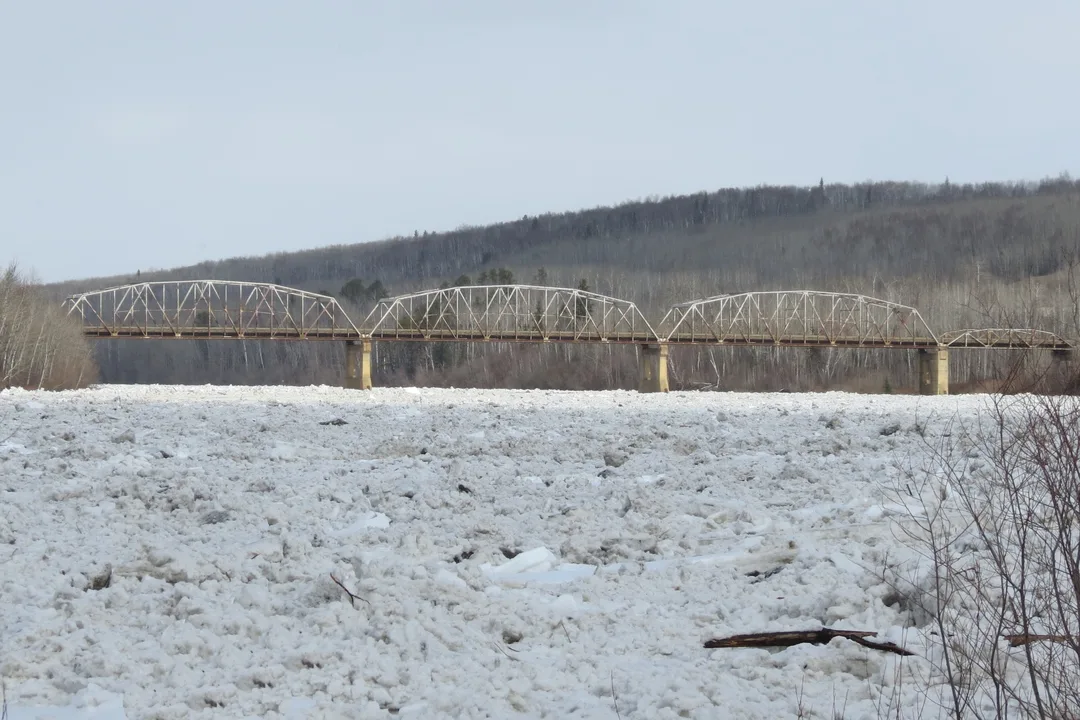
Ice jam on the Athabasca River, April 5, 2015. Athabasca Archives.
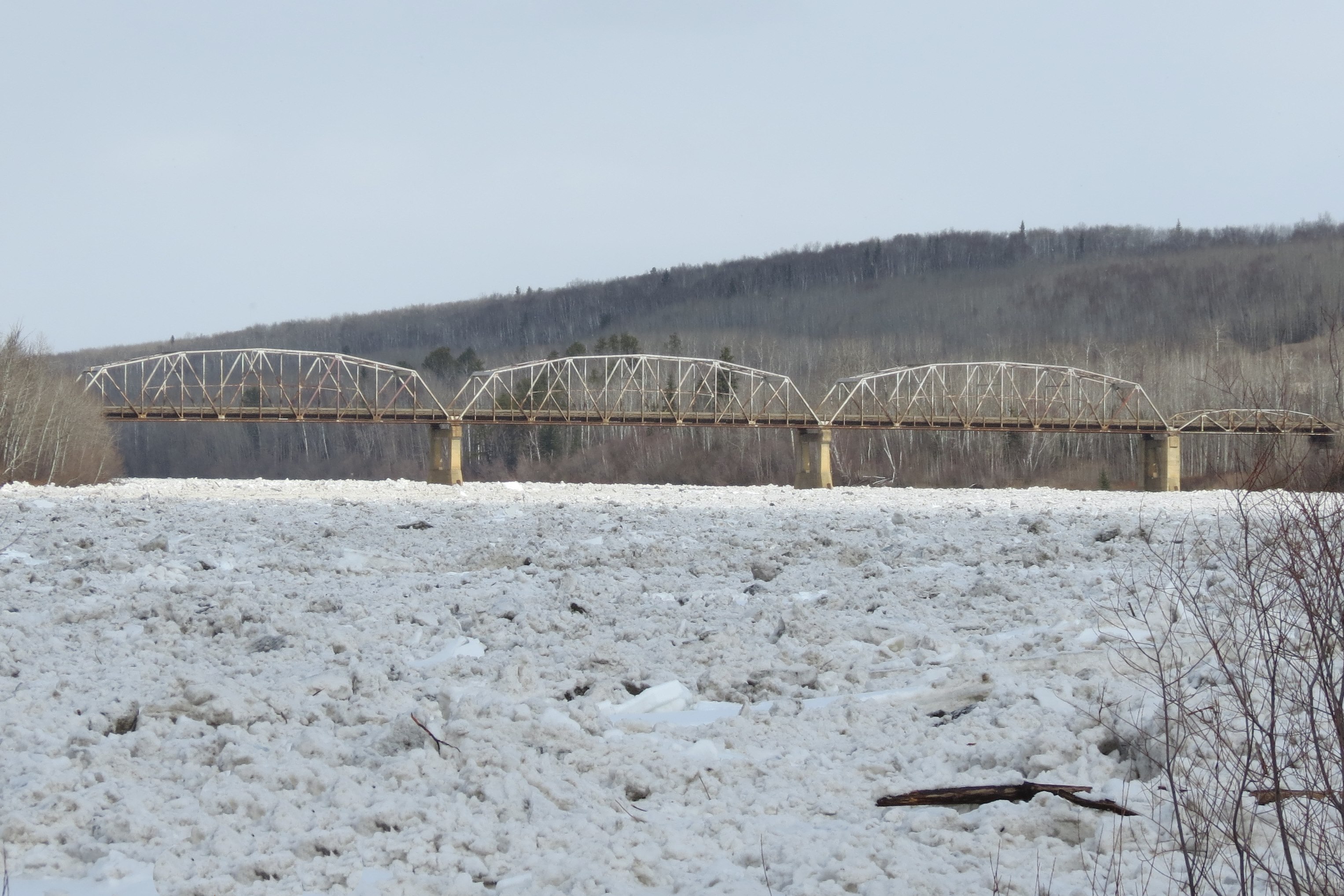
Five years later, in the 2017 Alberta budget speech, Alberta Finance Minister Joe Ceci announced in the Legislative Assembly that the province would replace the bridge. Athabasca-Sturgeon-Redwater MLA Colin Piquette said the bridge project has been moved from the province’s unfunded list to its capital plan. “This is something we are going to build. It’s just a question of when.” (Matthew Allen, March 21, 2017, Advocate)
In November of 2019 the funding was announced for a new bridge. In December the public consultation phase took place. An Athabasca Advocate headline on July 6, 2021, read “New Athabasca Bridge may be complete in 2023.” The headline “Shovels in the ground for new Athabasca bridge” appeared August 23, 2022.
The proximity of the new bridge to the existing bridge made narrowing the town end of the bridge imperative. When work began on the replacement bridge, it became necessary to limit the traffic to one lane permanently and lights were installed to control traffic. Wide loads were no longer able to cross and large farm and industrial equipment had to be diverted to the Al-Pac bridge – many additional miles of travel. Rig mats were laid on the old bridge which got rid of the need for the continual replacement of planking on the deck. Large metal plates were installed over holes in the approaches.
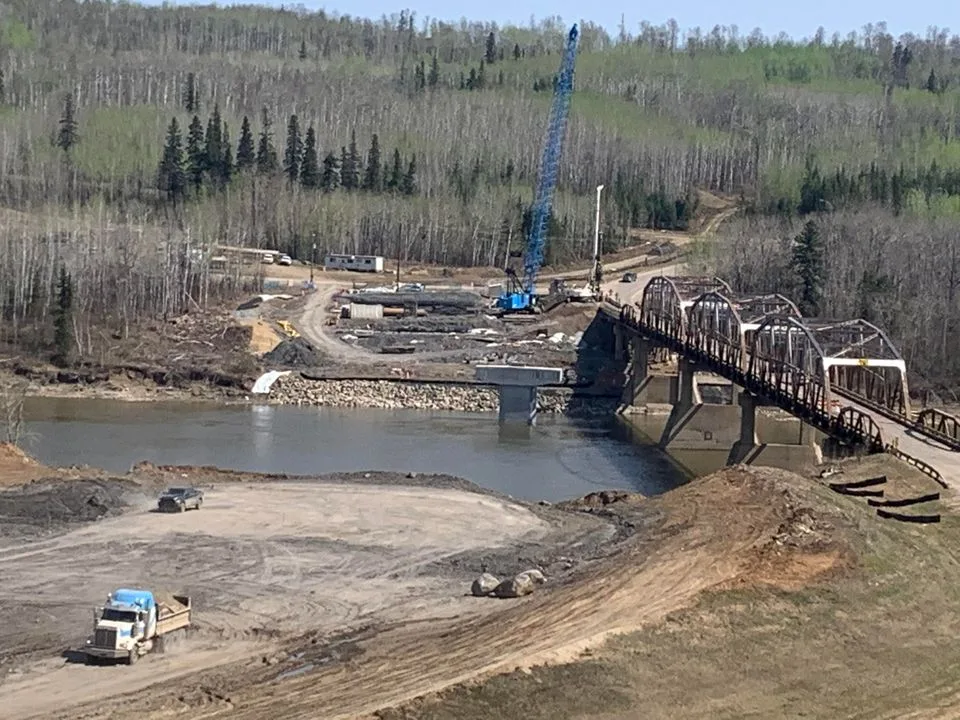
The new Athabasca Bridge construction, August 23, 2023. Photograph by Rory Couturier, Athabasca Archives.
North-siders fought long and hard for that bridge. She was a beautiful lifeline to the outside world and they were proud of her. But she was never built to handle the traffic caused by the increasing size and weight of farm equipment, the transporting of abundant natural resources, the myriad recreational opportunities to the north, the increased traffic brought about by the development of sub-divisions and acreages, and the opening of Highway 813. Gradually wear and tear has worn her down. It will be very hard to write River Crossings – The Old Bridge is Gone.
But it would be an understatement to say that bridge users are excited about the opening of the new bridge.